
Erectile dysfunction is now just a code bug
Deep Dive

Biology is code. An erection is a seven-node program. We are about to rewrite the bug.
Every man wants stronger erections. That understates it. The average male consumer will surrender almost everything else before he surrenders this one. It sits above status spend, above most of his health span, and quietly above a good deal of his rational self-interest.
When a want ranks that high and that durably, it stops being a preference and starts being a market. This is why a large slice of the bio/acc revolution will rear its head in terms of free cash flow per share by intervening cleanly at one or more of the seven nodes this article breaks down. The companies that win will be selling a precise action on a specific link in a chain that every man is running, every day, whether he understands it or not.
None of what follows is medical advice, and none of it should be read as such. But a first-principles grasp of the machinery is its own form of leverage. Once you can see the chain, you can see where every intervention acts, which ones are theatre, and which single node may govern the rest. That is the difference between buying a protocol and understanding a system. The first makes you a customer. The second makes you dangerous.
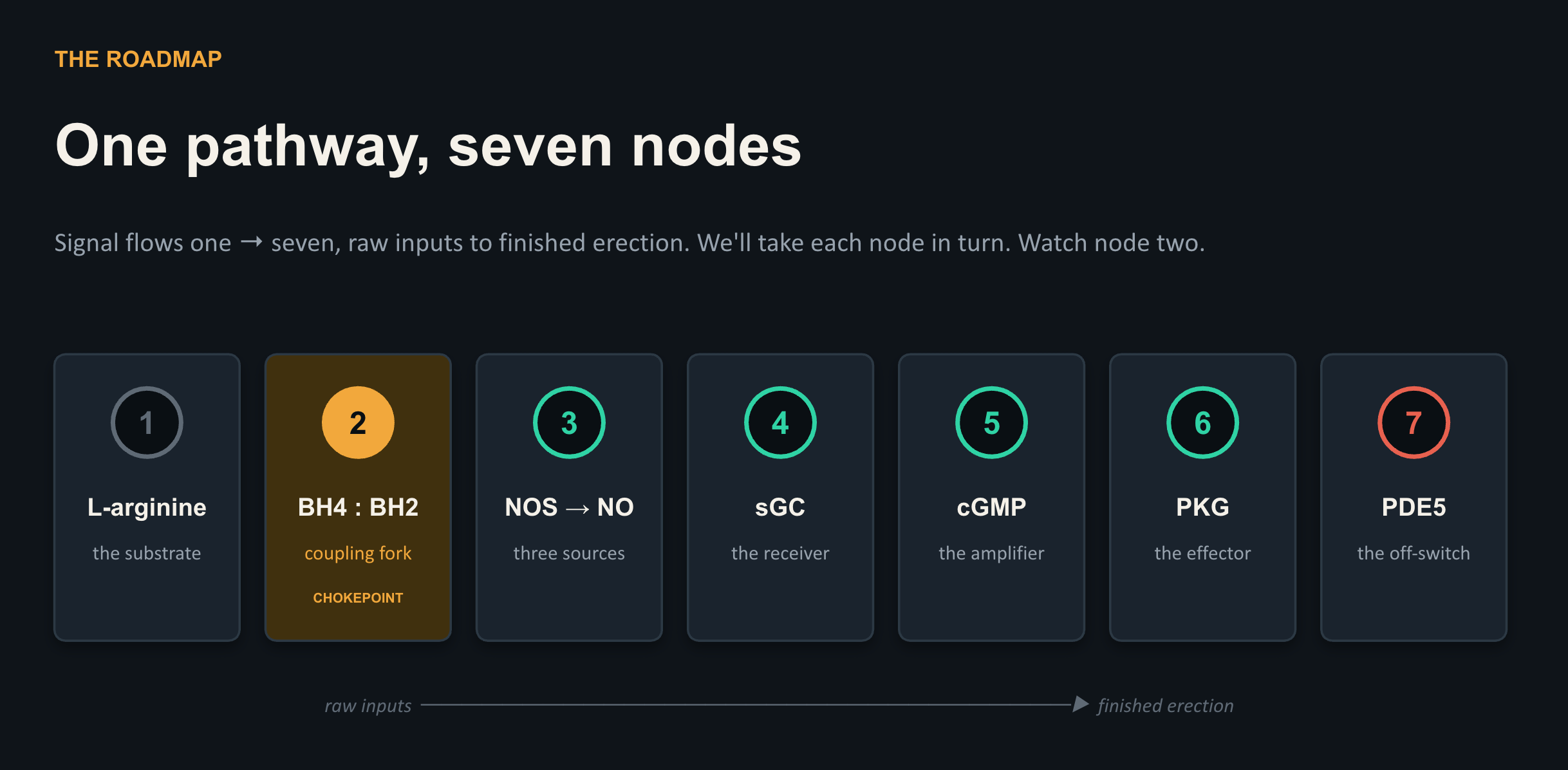
An erection is not a mood. It is a manufacturing line. Seven nodes, each handing off to the next, and if any node fails the product fails. Signal flows from node one to node seven, raw materials in at one end, rigidity out at the other. We are going to walk it in order.
Node 1: The Substrate
L-arginine plus oxygen, plus cofactors, feeding the NOS enzyme.
At the very top of the chain sit the raw materials. The enzyme that runs this whole show is nitric oxide synthase, NOS, and it needs two things: a substrate and a set of cofactors. The substrate is the amino acid L-arginine plus oxygen. The cofactors are NADPH, tetrahydrobiopterin (BH4), flavins, heme and calcium-calmodulin. Feed the enzyme correctly and it converts L-arginine and oxygen into nitric oxide plus L-citrulline. Note the framing: NOS is the machine, not the product. It is a catalyst. It does not get consumed, it processes inputs.
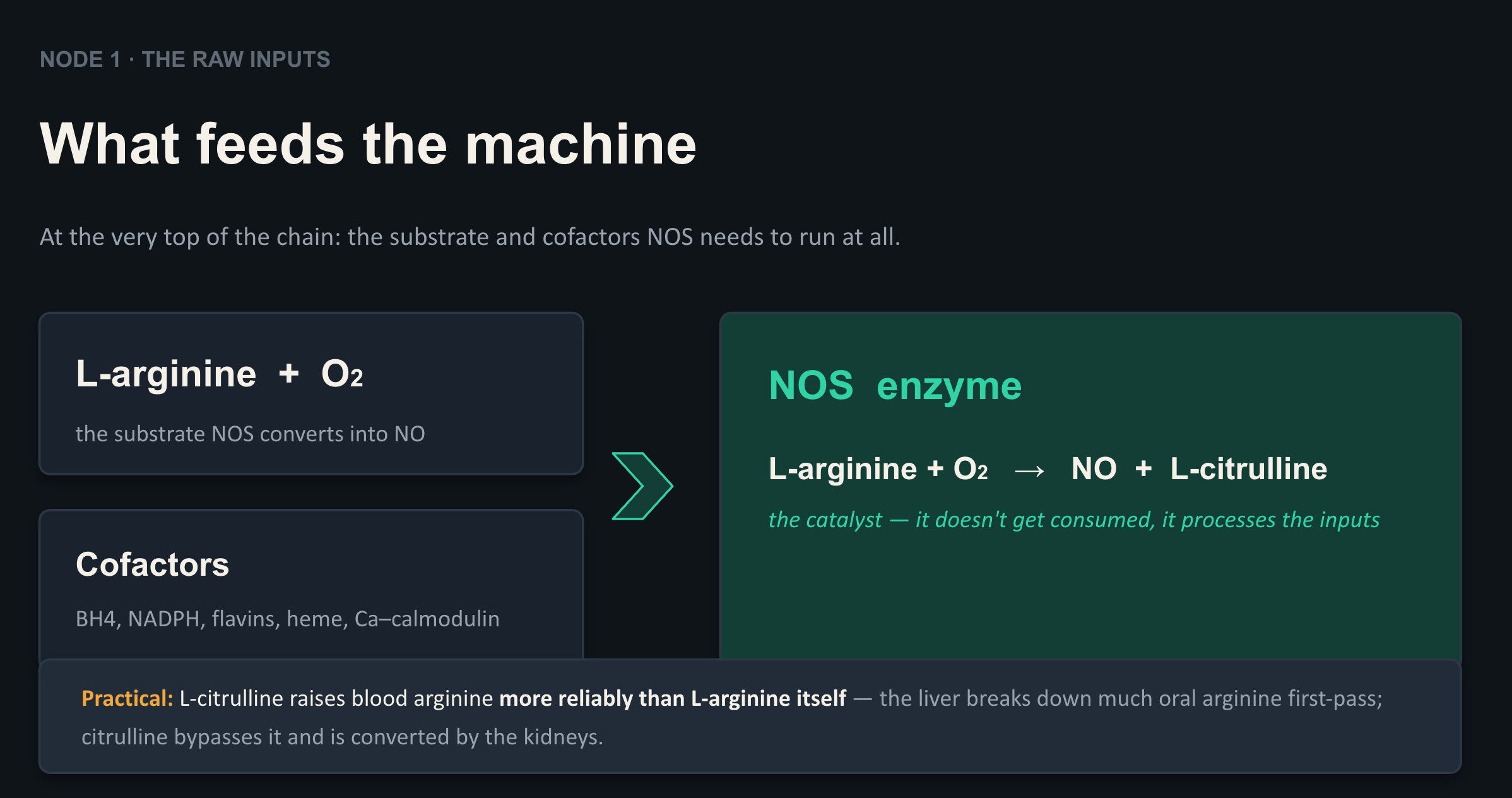
There is a practical detail here that most people get backwards. If you want to raise blood arginine, do not reach first for L-arginine. Reach for L-citrulline. The liver breaks down a large fraction of ingested arginine before it ever reaches the bloodstream. L-citrulline bypasses that first pass entirely and is converted back into arginine downstream by the kidneys. More substrate actually delivered, less lost to the liver.
Node 2: The Coupling Fork
One enzyme, two outcomes. Coupled gives NO. Uncoupled gives superoxide.
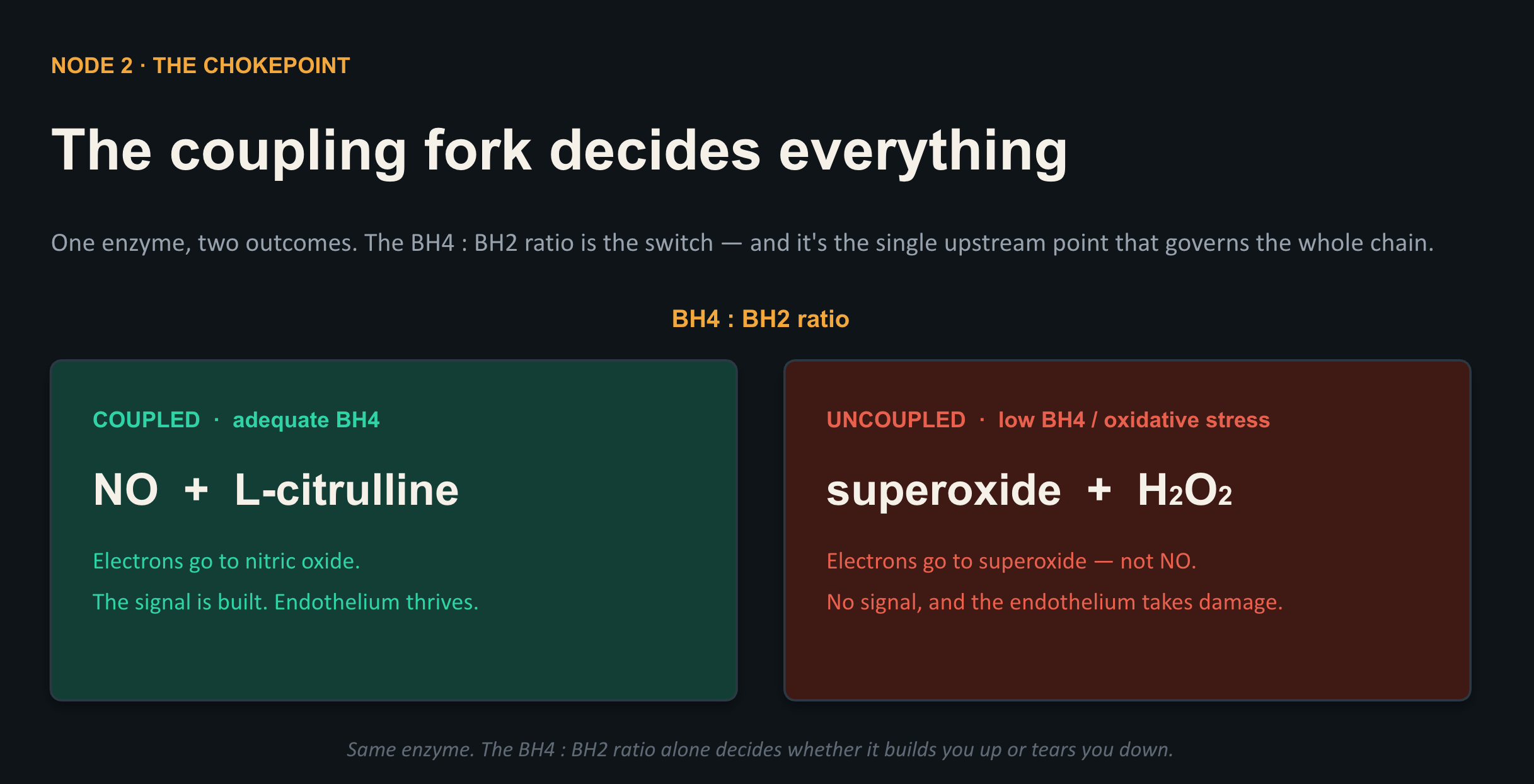
This is the most important node in the chain, and it is the one almost nobody talks about. The same NOS enzyme can run in two completely different modes, and a single variable flips it: the ratio of BH4 to its oxidised form, BH2.
When BH4 is adequate, NOS is coupled. Its electrons go where they are meant to go, into nitric oxide, and you get NO plus L-citrulline as a clean output. Good for the endothelium, good for you. When BH4 drops or oxidative stress climbs, NOS uncouples. The identical enzyme now sends its electrons to oxygen instead of arginine, and it spits out superoxide and hydrogen peroxide rather than NO. This is the quiet disaster of the whole system. Uncoupled NOS does not simply fail to produce signal.
It actively produces damage. Same machine, opposite output, and the only difference is a ratio.
Hold this in your head, because everything downstream, every sensor and messenger and effector we are about to meet, is helpless if this fork goes the wrong way. You can have a perfect pipeline below and it will not matter. No signal enters it.
Node 3: The Messenger and Its Three Sources
nNOS, eNOS and iNOS all make the same NO. They differ only in where, when, and how much.
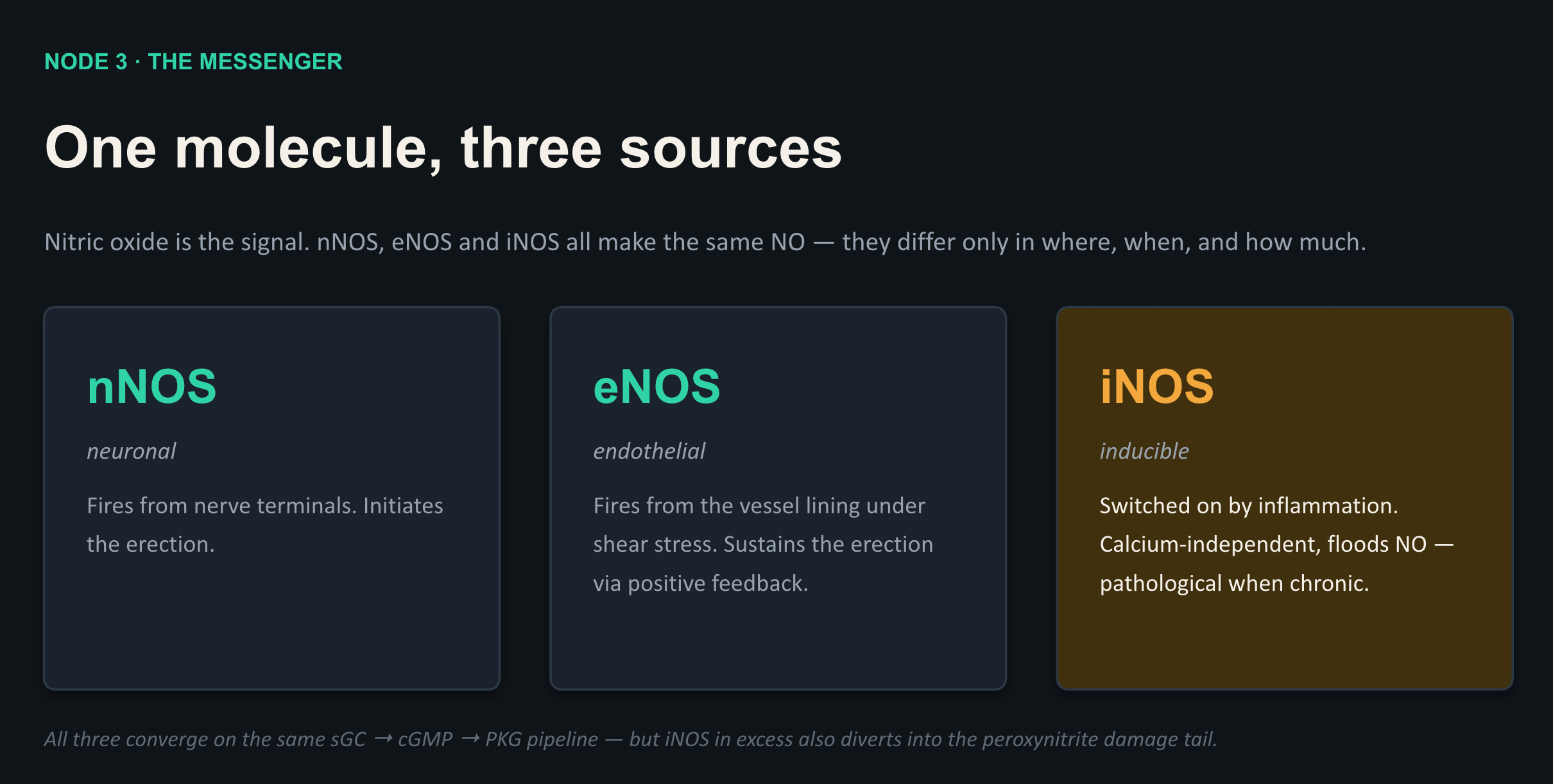
The messenger itself is nitric oxide, one small gas molecule. Here is a myth worth killing on the spot: there is no such thing as a distinct "endothelial NO" versus "neuronal NO" as different chemicals. It is the same NO. What differs is the factory that made it.
There are three isoforms of NOS in penile tissue. nNOS sits in nerve terminals and initiates the erection. eNOS sits in the endothelium, the vessel lining, and sustains the erection through a positive feedback loop. iNOS is the problem child. It is switched on by inflammation, it is calcium-independent, and it floods NO at up to a thousand times the constitutive rate for hours or days. In small, regulated doses NO is the signal. In the iNOS flood it stops being signal and becomes damage, because the excess NO reacts with superoxide to form peroxynitrite, a reactive nitrogen species that oxidises lipids, nitrates proteins and inactivates enzymes.
All three isoforms converge on the same downstream pipeline. Two of them build you up. The third, chronically active, tears you down.
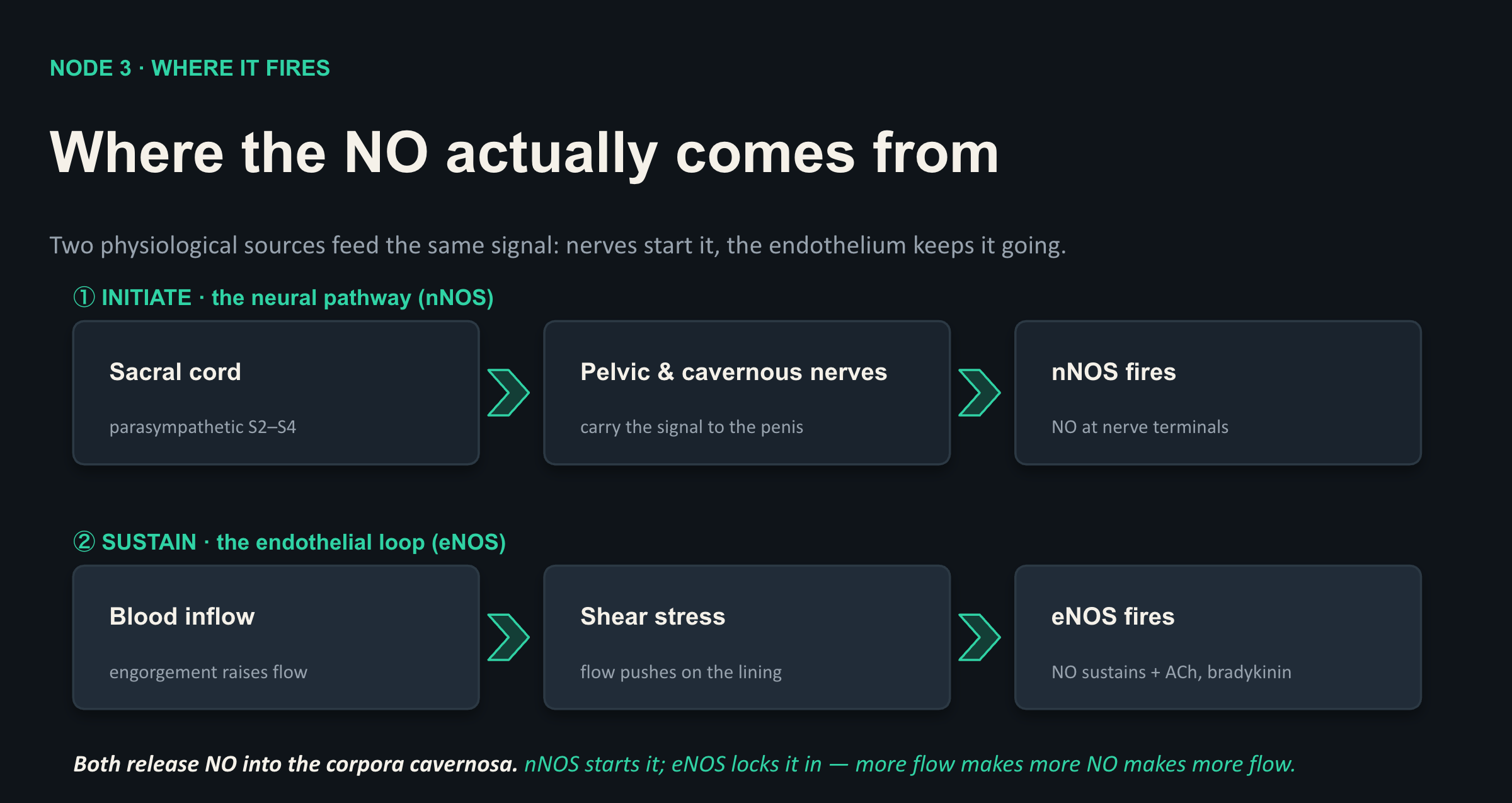
It helps to see where the first two physically fire.
Initiation runs on nerves. Sexual stimulation activates parasympathetic neurons out of the sacral spinal cord, segments S2 to S4. Those signals travel through the pelvic nerves and then the cavernous nerves into the penis, where nNOS at the nerve terminals releases the first pulse of NO. That is the match being struck.
Sustain runs on flow. Once blood floods into the corpora cavernosa, the flow itself drags on the endothelium, and that shear stress switches on eNOS, which keeps NO coming. Acetylcholine and bradykinin help trigger it too. And it is a loop: more flow makes more NO, which makes more flow. Nerves light it. The endothelium keeps it burning.
Node 4 to 6: The Signalling Pipeline
sGC senses the NO. cGMP amplifies it. PKG acts on the muscle.
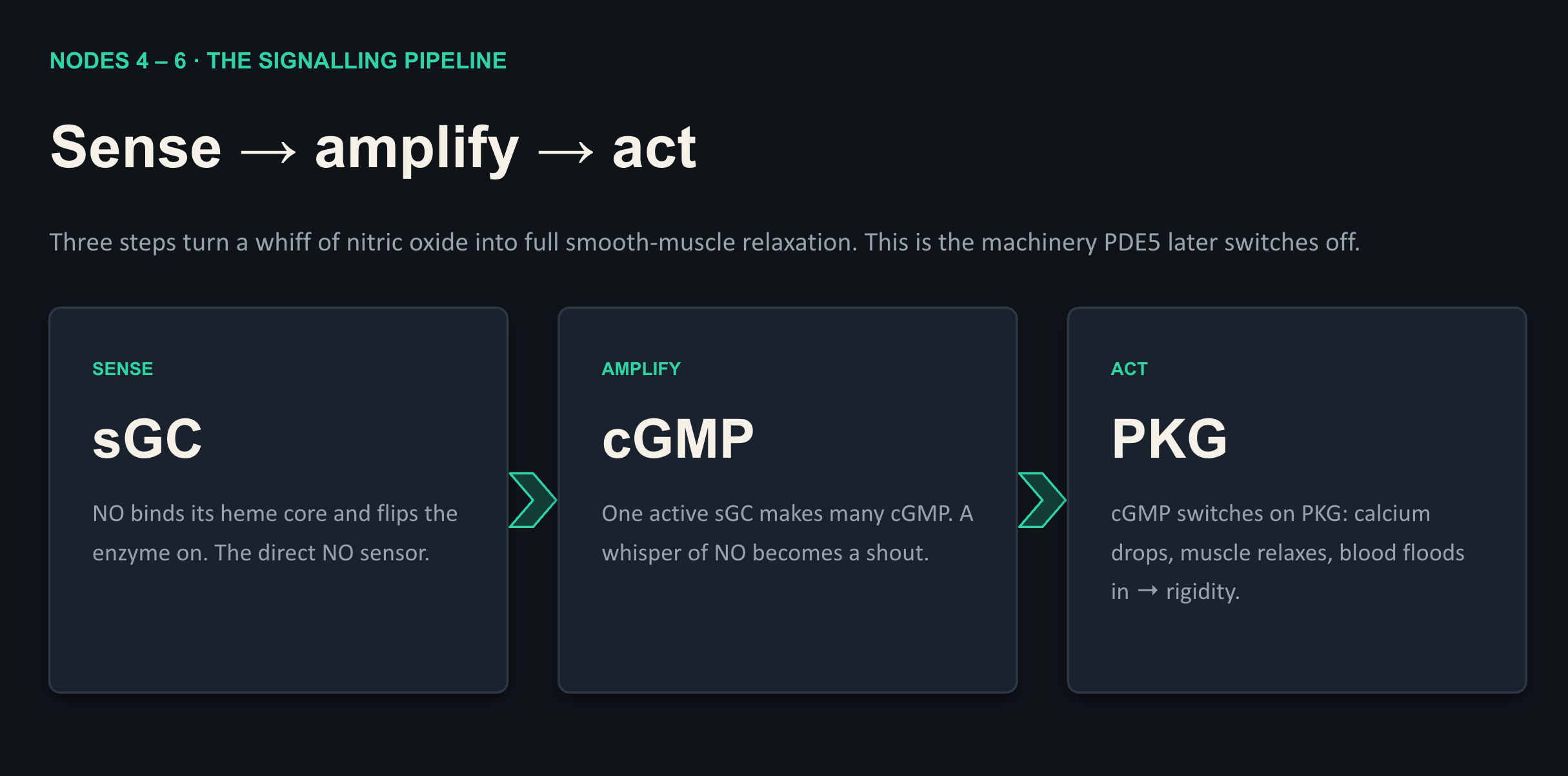
Once nitric oxide arrives, three steps turn a whisper into full smooth-muscle relaxation.
Sense. NO diffuses into the smooth muscle cell and binds the heme core of soluble guanylate cyclase (sGC), which flips the enzyme on. sGC is the direct NO sensor, the actual point of reception. Amplify. Activated sGC converts GTP into cyclic GMP (cGMP), and it does so in bulk. One active enzyme makes many messengers, so a faint NO signal becomes a loud one. Act. Rising cGMP switches on protein kinase G (PKG), which does the muscular work: it drops intracellular calcium, opens potassium channels, and dephosphorylates myosin.
Calcium falls, the muscle lets go, the arteries open, blood floods in, and you get rigidity.
Sense, amplify, act. Note that cGMP, the molecule being amplified here at the middle of the pipeline, is the exact molecule that gets destroyed at the end. Same messenger, opposite ends of the story.
Node 7: The Off Switch
PDE5 hydrolyses cGMP into inactive GMP. This is where Viagra acts.
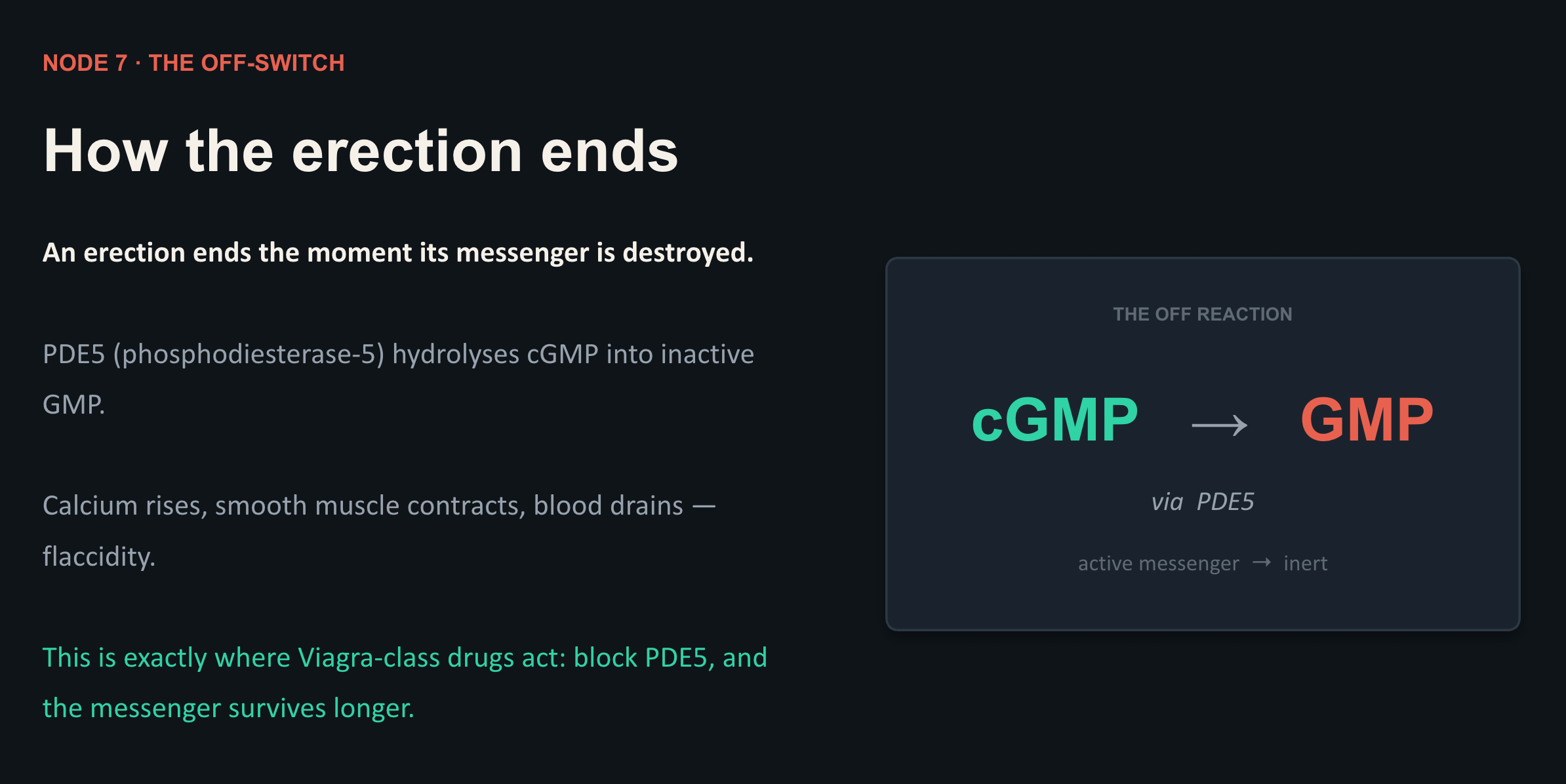
An erection ends the moment its messenger is destroyed. The enzyme phosphodiesterase type 5 (PDE5) hydrolyses cGMP into inactive GMP. With the messenger gone, calcium rises, the smooth muscle contracts, blood drains, and you return to flaccidity.
This is where the entire pharmaceutical erection industry lives. Viagra and its cousins do not create anything. They do not add NO, they do not build cGMP, they do not touch the pipeline above. They block PDE5, the shredder, so that the cGMP you already made survives longer. Which means, and this is the part almost every advertisement quietly omits, they only work if the upstream line is actually producing. Block the drain on an empty tank and nothing happens. If your problem is upstream, at the coupling fork or the substrate, a PDE5 inhibitor is treating the wrong node.
The Flywheel
The chain has memory. The coupling fork at node two is not a static switch. It is a wheel, and it spins in two directions.
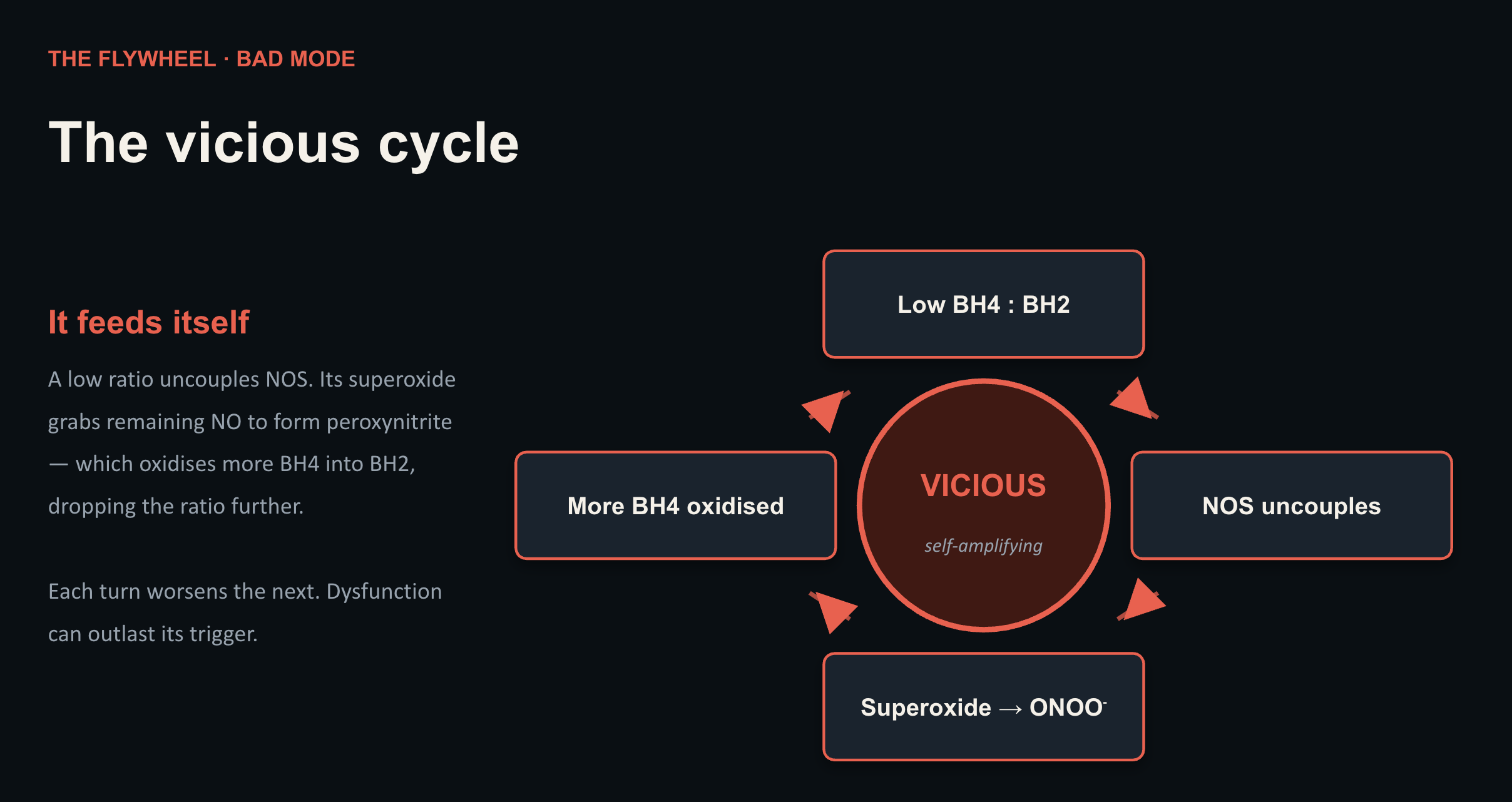
Watch the bad direction first. A low BH4 to BH2 ratio uncouples NOS. Uncoupled NOS makes superoxide. Superoxide grabs whatever NO is around and forms peroxynitrite. Peroxynitrite then oxidises more BH4 into BH2, which lowers the ratio further, which uncouples more NOS. Each turn of the wheel makes the next turn worse. This is why a bad patch does not simply pass on its own. The wheel keeps spinning on its own momentum long after the original insult has gone. Dysfunction can outlast its own cause.
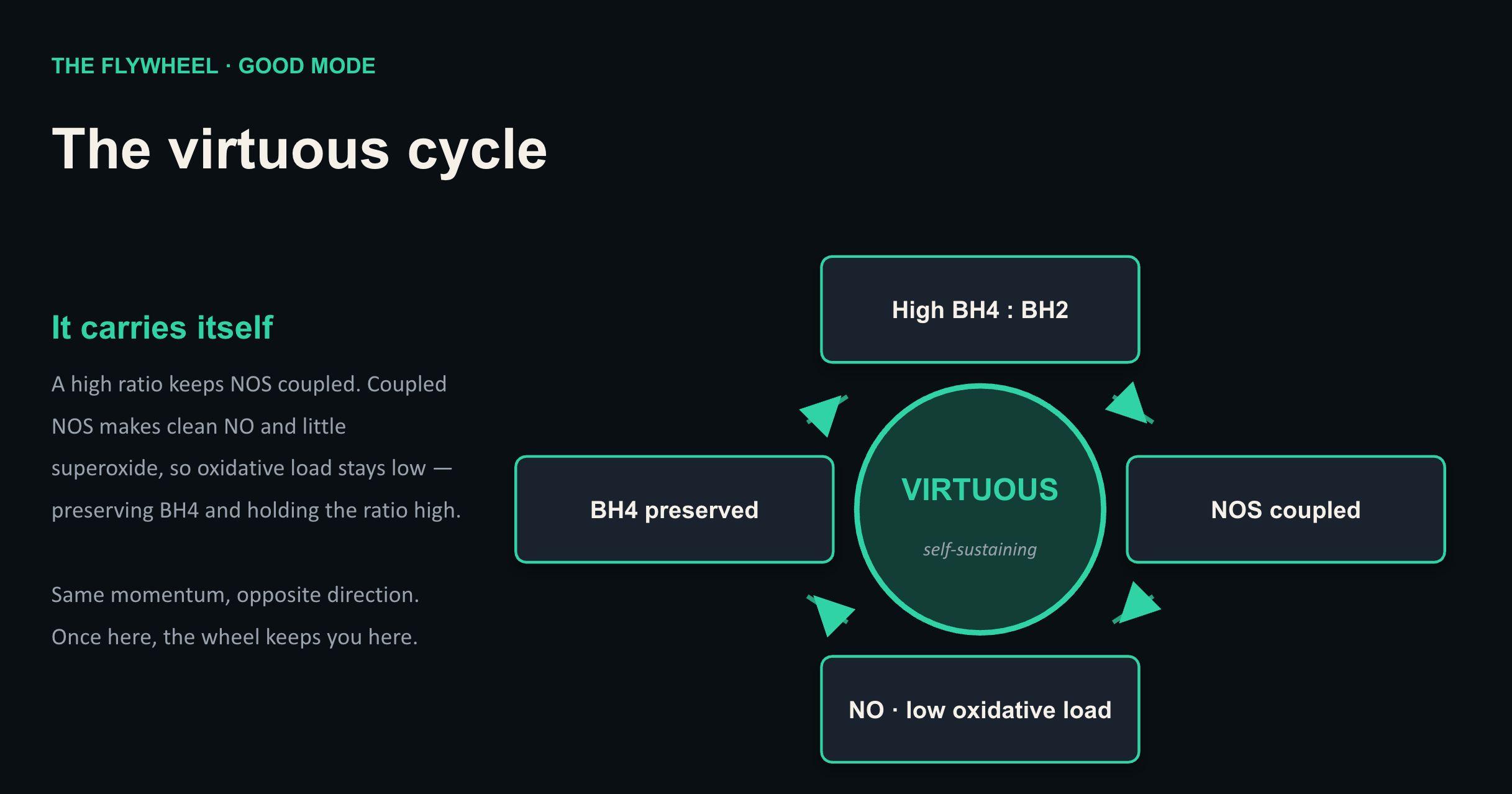
Now spin it the other way. A high ratio keeps NOS coupled. Coupled NOS makes clean NO and very little superoxide, so oxidative load stays low. Low oxidation means BH4 is preserved and recycled, which holds the ratio high, which keeps NOS coupled. It is the identical self-reinforcing structure, running for you instead of against you. This is the good news buried inside the bad news. The same momentum that makes dysfunction sticky makes healthy function sticky too. Get the wheel turning the right way and hold it there, and it starts to hold itself.
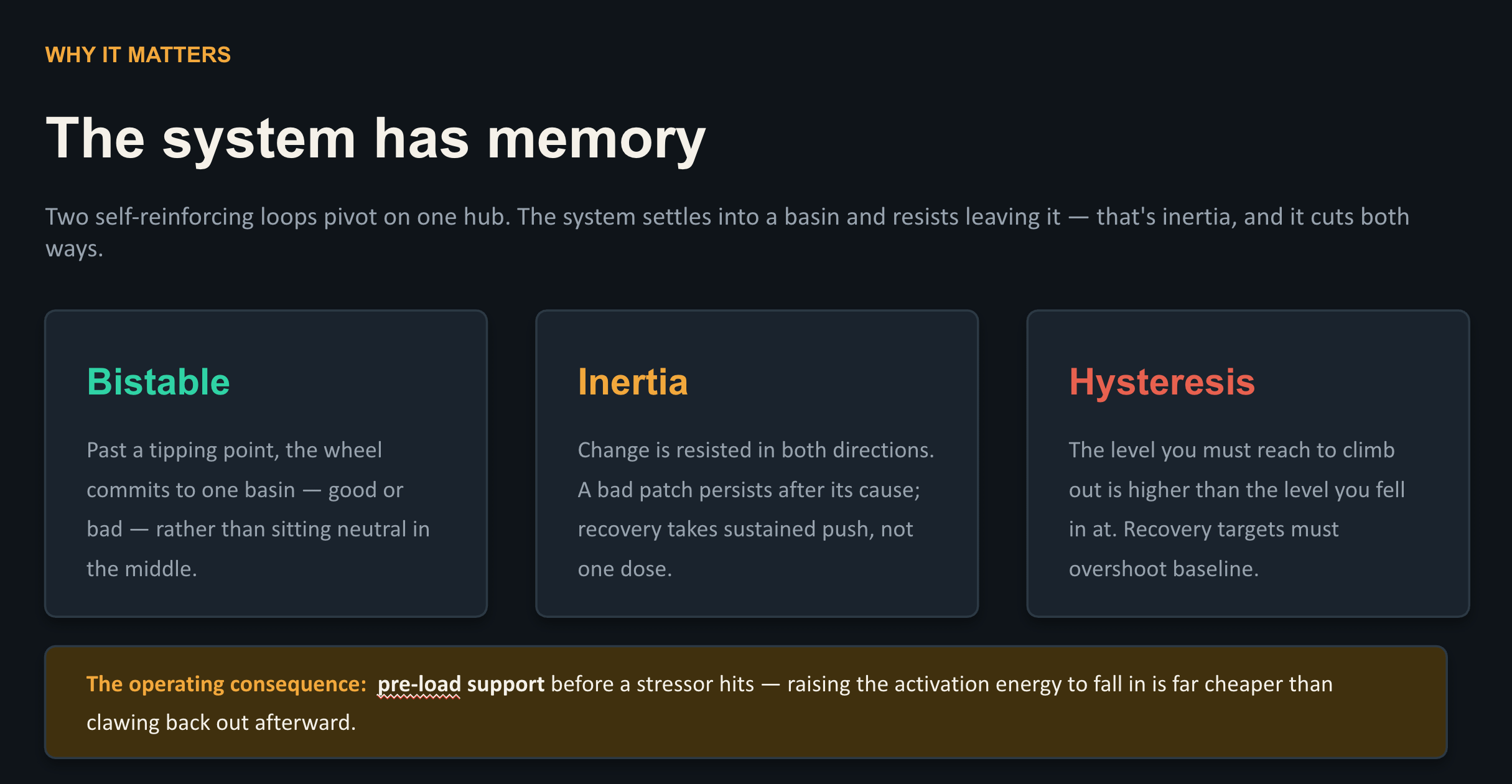
Two self-reinforcing loops pivot on one hub, the BH4 ratio. A system built like this is bistable. It does not float in the middle. It settles into one basin and resists leaving it. That gives it three properties worth naming. It is bistable, so past a tipping point it commits to one side. It has inertia, so change is resisted in both directions, which is why a bad patch persists and why recovery takes a sustained push rather than a single dose. And it shows hysteresis, meaning the level you must reach to climb out is higher than the level at which you fell in. Recovery has to overshoot baseline, not merely return to it.
Everything above is a reading. For most of history that is all we could do with biology: read it, slowly and expensively, and hope to nudge it at the edges. That era is ending. The ability to read and write biology is rising exponentially while the cost of doing so collapses. Sequencing, synthesis, and the models that now sit on top of them are on the same kind of curve that took compute from a room to a pocket. Biology is becoming an information technology, and information technologies do not improve linearly. They improve until the old constraints simply stop being constraints.
Which is exactly why a map like this one matters more now than it ever has. An exhaustive molecular account of the erection value chain is not trivia. It is a specification. Once you can read every node, every enzyme, every cofactor and every feedback loop with precision, you know precisely what has to be written to fix a fault. The problem stops being a mystery and becomes an engineering brief. You are no longer poking at a black box. You are editing a known circuit.
Almost the entire commercial history of erectile dysfunction lives at node seven. The blockbusters block PDE5, the drain, because node seven is the easiest node to reach and the easiest to dose. It is a real intervention and a real business, but it is one node out of seven, and it is the last one. Everything upstream, the substrate, the coupling fork, the synthases, the sensor, the amplifier, the effector, has been left largely untouched. Not because it did not matter, but because until recently we could not read it well enough to write it.
That is the gap, and it is enormous. As reading and writing biology gets cheaper and better, every node upstream of seven becomes addressable. Restore the coupling fork instead of bypassing it. Rebuild endothelial NO output at the source instead of guarding the last molecule of cGMP from a shredder. Repair the nerves, tune the isoforms, correct the substrate. Each of these is a writing problem, and each is now, for the first time, tractable. The company that stops treating the symptom at node seven and starts rewriting nodes one through six is not selling a better pill. It is making erectile dysfunction history.
⚡ If you enjoyed the post, please feel free to share with friends, drop a like and leave me a comment.
You can also reach me at:
Twitter: @alc2022
LinkedIn: antoniolinaresc
Strong piece, and the flywheel section is the part that earns the whole framing.
Your own loop may undercut the node seven dismissal, though. You have eNOS switched on by shear stress, with flow driving NO driving more flow. A PDE5 inhibitor raises flow. Raised flow raises shear, which activates eNOS, which puts NO back into the pipeline. So the drain blocker does reach upstream, through the feedback loop you drew. Given your hysteresis point that recovery must overshoot rather than return, node seven looks less like the wrong node and more like the cheapest place to push the wheel.
So which company does this?