
NervGen's Future.
Update

This is an update of my original NervGen deep dive.
NervGen's real moat isn't the peptide, it's mapping the nervous system to sell targeted, monetisable outcomes.
In 10 years, customers won't be inclined to pay for an amino acid sequence they can copy-paste from the internet and print at home. Over time, they'll be increasingly delighted to pay for outcomes. This has important implications not just for NervGen, but for any company working on peptides (which are just strings of amino acids): the industry will revolve around patient outcomes rather than abstract trial designs.
NervGen trial participants said something to me in last week's podcast that has been resonating in my head since: "give us the hands." They knew regaining full mobility would be a stretch (right now), but they had already experienced functional gains on NVG-291 that had meaningfully improved their lives — bowel function and hand movement, among others. The trial revolved around a single endpoint, while patients were receiving value across various functional dimensions that their physicians seem to be ignoring to this day.
They really wanted the hands back.
If NVG-291 does indeed yield axonal regrowth, it's hypothetically possible to direct the peptide at specific regions of the nervous system to regain specific function. As we reviewed last week, for example, nitric oxide synthase (the primary precursor of erections) originates from the S4 region of the spinal cord. Would adding a functional unit to direct NVG-291 to the S4 region help improve the sexual function of spinal cord injury patients? Would doing the same to direct it to the C6–C8 region help patients get their hands back?
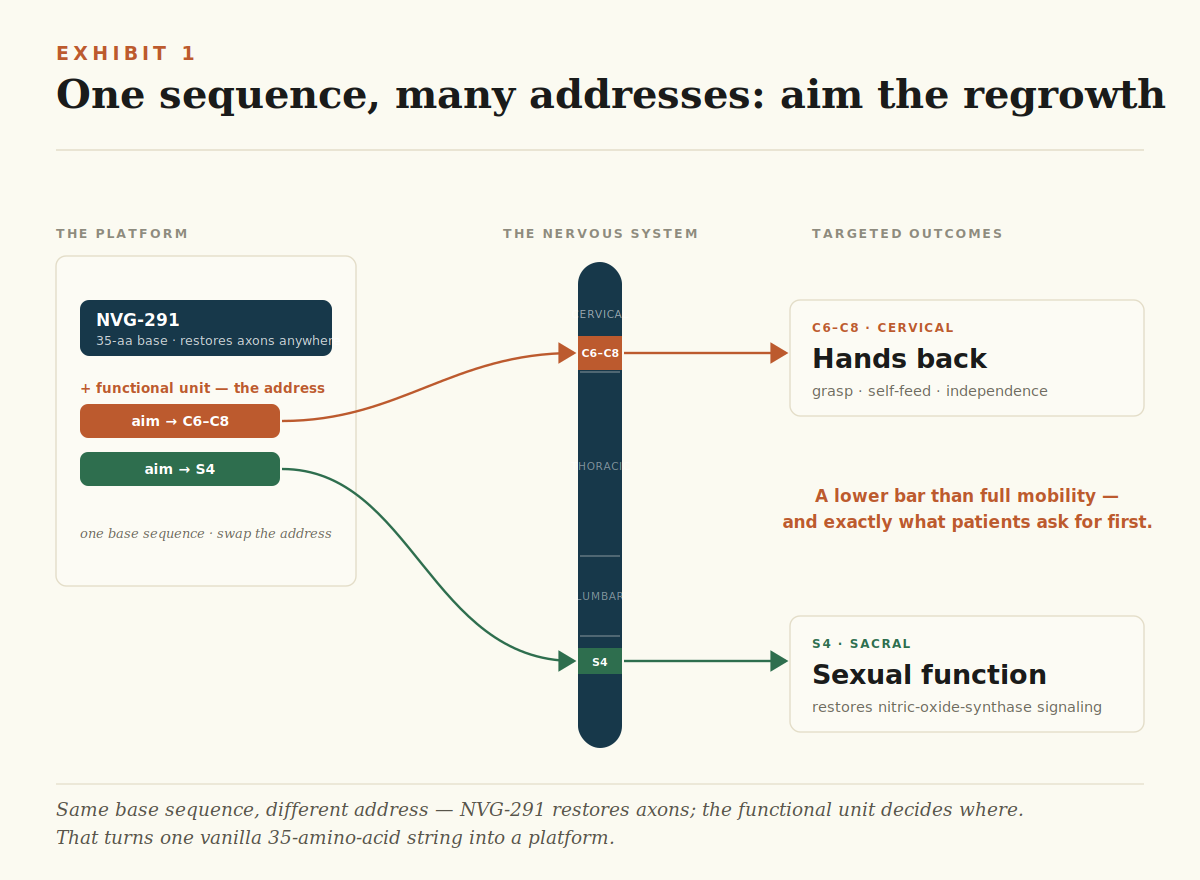
This has two implications:
Regaining sexual function and hand movement, for example, is a lower bar than regaining full mobility and customers really care about this.
This presents a far lower-friction path to delivering more value to end customers per dollar spent and toward positive cash flow for the company.
Like all other promising peptides, NVG-291 is a relatively vanilla amino acid sequence. But in this light it can act as the basis for a platform: adding functional units to the sequence can hypothetically direct the peptide anywhere in the body and restore axons there. Which specific functional units have to be added to drive optimal outcomes for a specific patient is far harder to imitate than copy-pasting the 35-amino-acid sequence that NVG-291 truly is. This is something customers will be increasingly inclined to pay for.
The nervous system is the body's internet. It can go wrong in an infinite number of ways: critically so not just for spinal cord injury patients, but also those with multiple sclerosis, ALS, stroke, and Parkinson's, to name a few. As you can see below, as well as motion the nervous system regulates the function of a wide range of organs. Although it's tempting to sort nervous system dysfunction into discrete buckets, the spectrum is a continuum: meaning the nervous system can both go wrong and be fixed in many places, to the benefit of patients.

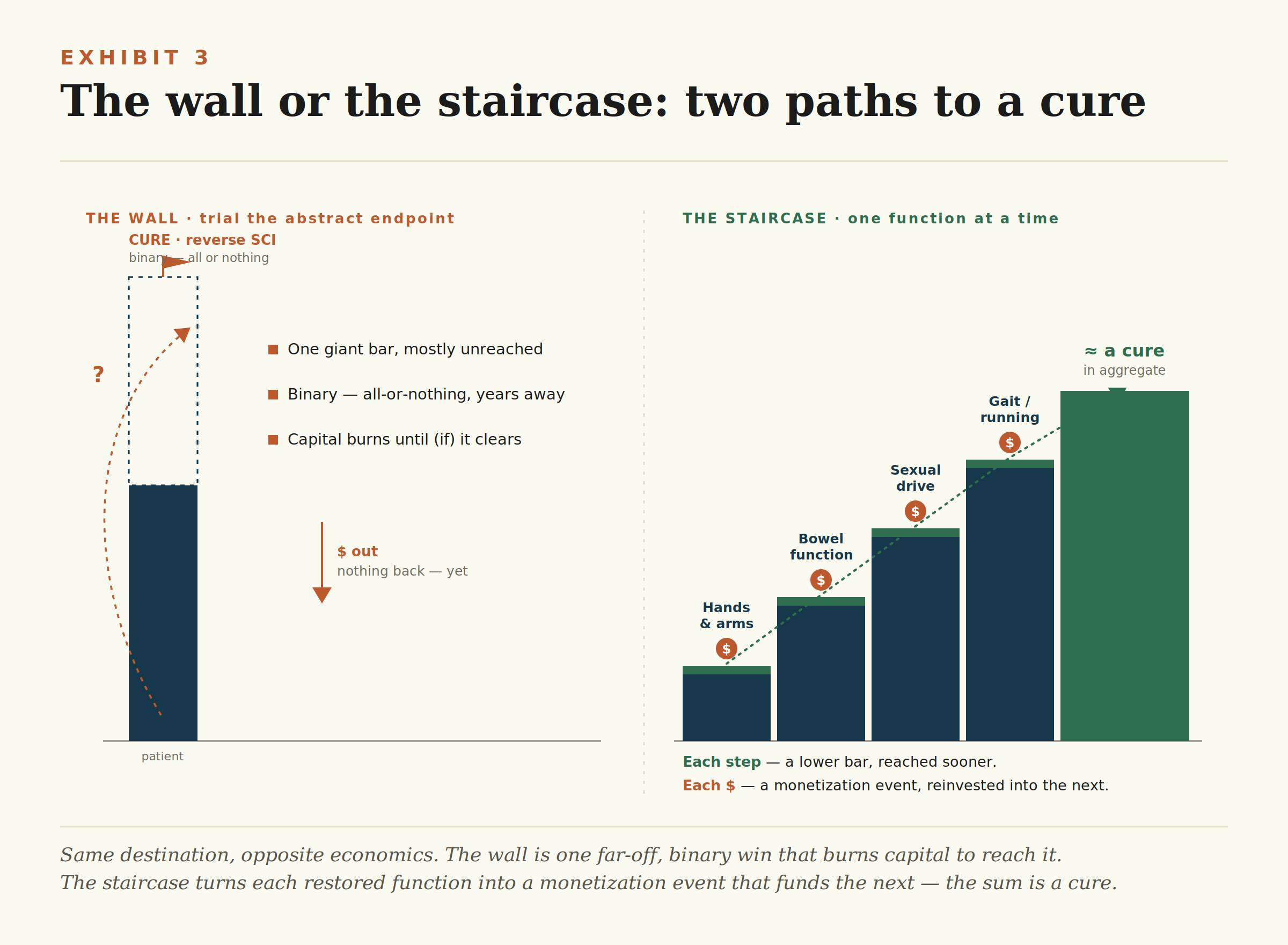
Patients don't care about trial endpoints so much as regaining specific function. The company's path to positive cash flow can be meaningfully derisked by asking customers which function they most want back and targeting the peptide in that direction. As mentioned, trialing hand movement is a far lower bar than trialing "reversing spinal cord injury" in the abstract and in the short term, far more achievable.
Over the long term, the aggregate of specific functional gains will tend to equate to a cure. A spinal cord injury patient who can move their hands and arms, has regained bowel function, has sexual drive, and can run is no longer much of a spinal cord injury patient or at least not one who feels like one. Each functional restoration is a monetisation event which yields capital that can be reinvested into driving better outcomes to patients per dollar spent.
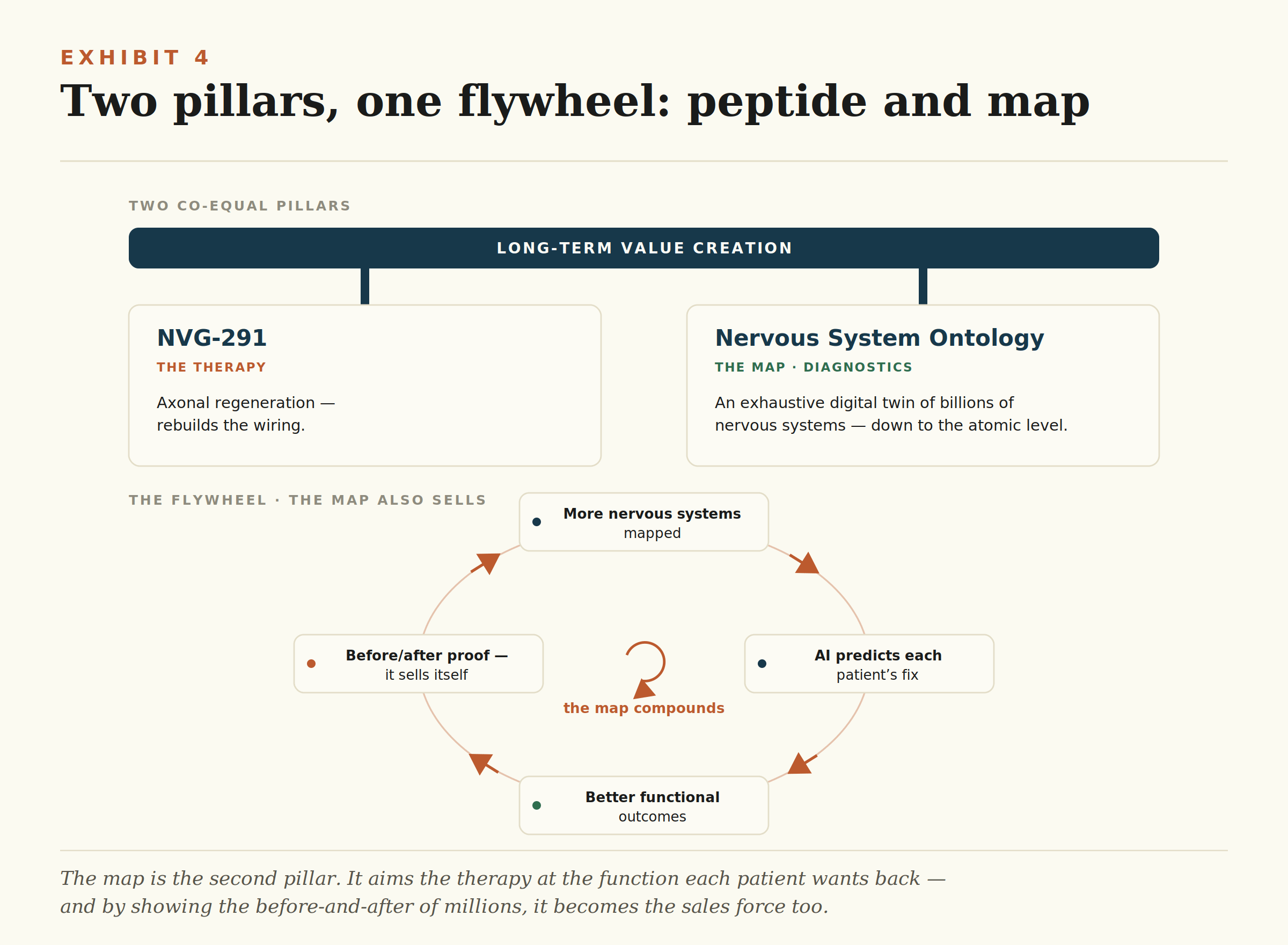
In this light, the business is not so much about getting a peptide approved as it is about building a map of the nervous system that can be fed into AI, so the AI grows increasingly able to predict what each patient should do to restore nervous system function. Show an AI enough examples of nervous systems — ideally all the way down to the proteomic and even atomic level — and what happened to each after a given intervention, and it will get very good at figuring out who needs what.
In tech we call this an Ontology: an exhaustive digital representation of an analogue artefact. Having billions of nervous systems worldwide mapped down to the atomic level allows you to understand what makes them better or worse over time. In this sense, a Nervous System Ontology is equally important for long term value creation as is NVG-291 as the basis for axonal regeneration. The diagnostic layer is what enables focusing on specific functional restoration and simultaneously, the best possible sales force for the product.
No one with nervous system damage will hesitate much to use NVG-291 if they can see the succesful before and after of millions of nervous systems.
Further, as I've explained many times, peptides are just the tip of the iceberg. They are a shortcut in a value chain that runs a lot deeper. The same end output can be achieved by modulating the epigenome, editing the genome, and/or inserting new cells that print whatever we want them to print. For example, we could in theory modify the genome to get a certain part of the nervous system to express NVG-291 for a set period and then revert it back to not printing NVG-291. This technology isn't mature yet, but it will be relatively soon, and it'll be far more convenient for customers than a daily injection.
What this means is that to truly optimise for long term value creation, the platform has to be abstracted from scratch to deliver everything from peptides to the complex molecules that let us edit genes. The combination of targeted NVG-291, epigenetic tuning (getting cells to read the underlying genetic code better), and gene editing will likely beat NVG-291 alone. Further, inserting new cells into the tissue that print NVG-291 autonomously may be better than the entire stack above, both in price and convenience. In this sense, thinking only along the peptide route is a relatively sure way to get disrupted over time.
The entire essay can be summarised as follows:
Build a read function to get an exhaustive view of many nervous systems.
Ask customers which function they most want to get back.
Prioritise the most demanded functions and screen before and after.
Use that data to train an AI that gets really good at predicting what each customer has to do to obtain the most value per dollar.
Write back into the nervous system with a platform that can deliver NVG-291 to the optimal location and, increasingly, any intervention deeper down the value chain.

An additional and important consideration is that not all jurisdictions are equally focused on patient outcomes. However, a diagnostic layer that shows before and after systematically working out sells itself worldwide. As Immunity Bio is doing, gaining approval abroad and reinvesting capital into being well positioned for hypothetical approval in the US (and in a growing number of jusrisdictions) is better than simply waiting for approval in the latter.
⚡ If you enjoyed the post, please feel free to share with friends, drop a like and leave me a comment.
You can also reach me at:
Twitter: @alc2022
LinkedIn: antoniolinaresc
Great read Antonio , really enjoying your work
Hope you are able to get your ideas to Nervgen management or that they are interested in outside feedback enough to go looking for it like us true believers. So far they haven't impressed me as being highly motivated to find or receive feedback.