
Block: "We're Increasing Talent Density."
Q3 and Q4 2025 ER Digest

This is an update of my original Block deep dive and Q3 2023 ER Digest.
Block has gone from broken to seemingly compounding, which merits an ongoing review of my assessment of its management back in 2023.
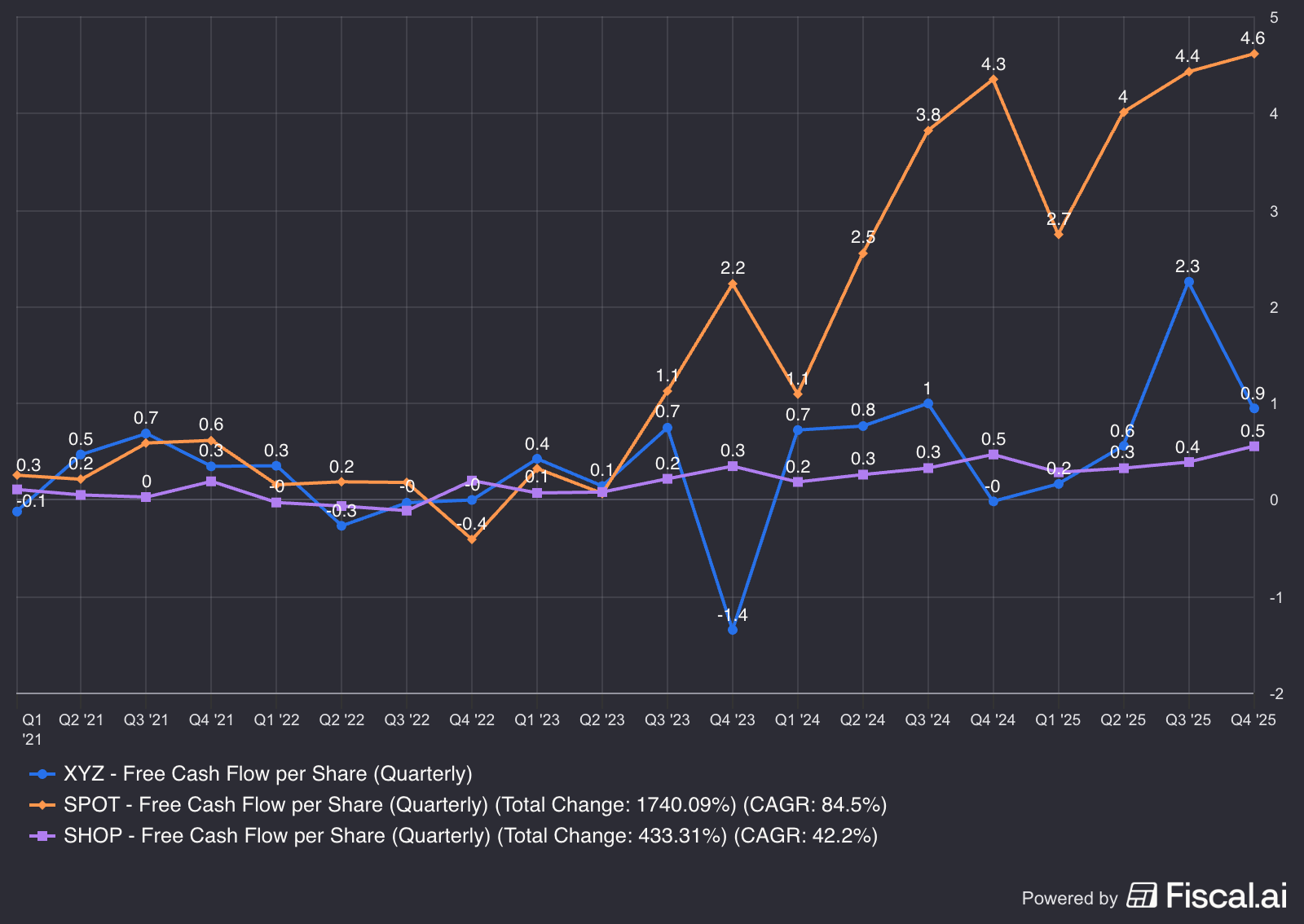
Ironically, Block is now testament to my view that organisational traits are among the best predictors of financial performance. A few years ago it was a pain to read Block's earnings call transcripts. Today, the company exudes focus and clarity and the ultimate sign of this shift is the rapidly rising free cash flow per share, that you can see depicted below (orange line). This has been brought about by four main factors, which have compounded since early 2024:
Unifying Block’s organisational structure (from two companies to a single one) and increasing talent density.
Leverage AI capabilities to ship faster, which according to Jack went through an inflection point in December 2024.
Streamlined pricing, together with a more focused field sales force.
New buyer features driving non-linear engagement increments across the network.
The company is now smaller, faster and much more focused on delivering more value to end customers per dollar spent. If you read the last few earnings call, you will see this too.
We’re also inherently increasing talent density across the org, including the development org. And obviously, we’re getting all the benefits of the AI tools and the improvements in the foundational models, and that’s flowing through to everything that we’re doing, particularly on the software development side.
-Owen Jennings, Block’s Business Lead, during the Q4 2025 earnings call.

As you can see above, the market isn’t quite buying this “shift” and I don’t have a great deal of conviction either. However, Block’s fundamentals today are noteworthy:
They’re sitting on a Payments/Lending Ontology which is fairly impossible to replicate at this stage: 59M MAUs on the Cash App side and a GPV of $67.2B in Q4 2025.
This affords them plenty of proprietary data, which they can use to resell intelligence to both sides of the marketplace: a CFO for buyers and a COO for merchants, as Jack put it.
As is the case with Shopify and Spotify, which are also leveraging agentic tech correctly, this positions Block to bring a whole new level of personalisation to customers.
And I do believe that a lot of the expectation going forward is not just that we deliver intelligence to our customers through Managerbot and Moneybot, for instance, but the very end of that is that they can build their own features and build their own visualisations on top of our capabilities through our interfaces.
We have incredible distribution.
We have incredible understanding in real time of real transactional data on both sides of the counter.
-Jack Dorsey during Block’s Q4 2025 earnings call.
Putting the loan origination risk aside, there’s plenty of continuity to Block’s current trajectory per the aforementioned non-linear engagement increases, being unlocked by incremental features on the buyer side. For example, management shared in the Q3 2025 earnings call that Borrow (cash advance feature within Cash App) actives had 3X higher inflows and 2X higher Cash App Card spend and 3X higher retention rate than non-Borrow actives. In Q4 2025 they shared that banking (Cash App's FDIC-insured deposit account with a debit card.) actives had 10X higher engagement than only peer-to-peer actives.
As previously mentioned, AI is clearly enabling Block to figure out what customers want and ship faster, which makes me think we’ll continue to see non-linear earning power improvements. Indeed, Block as a lot of competition, like perhaps Shopify, but it appears that its biggest competitor was itself. Once they fixed the organisational structure and got more focused, the financials are improving rapidly.
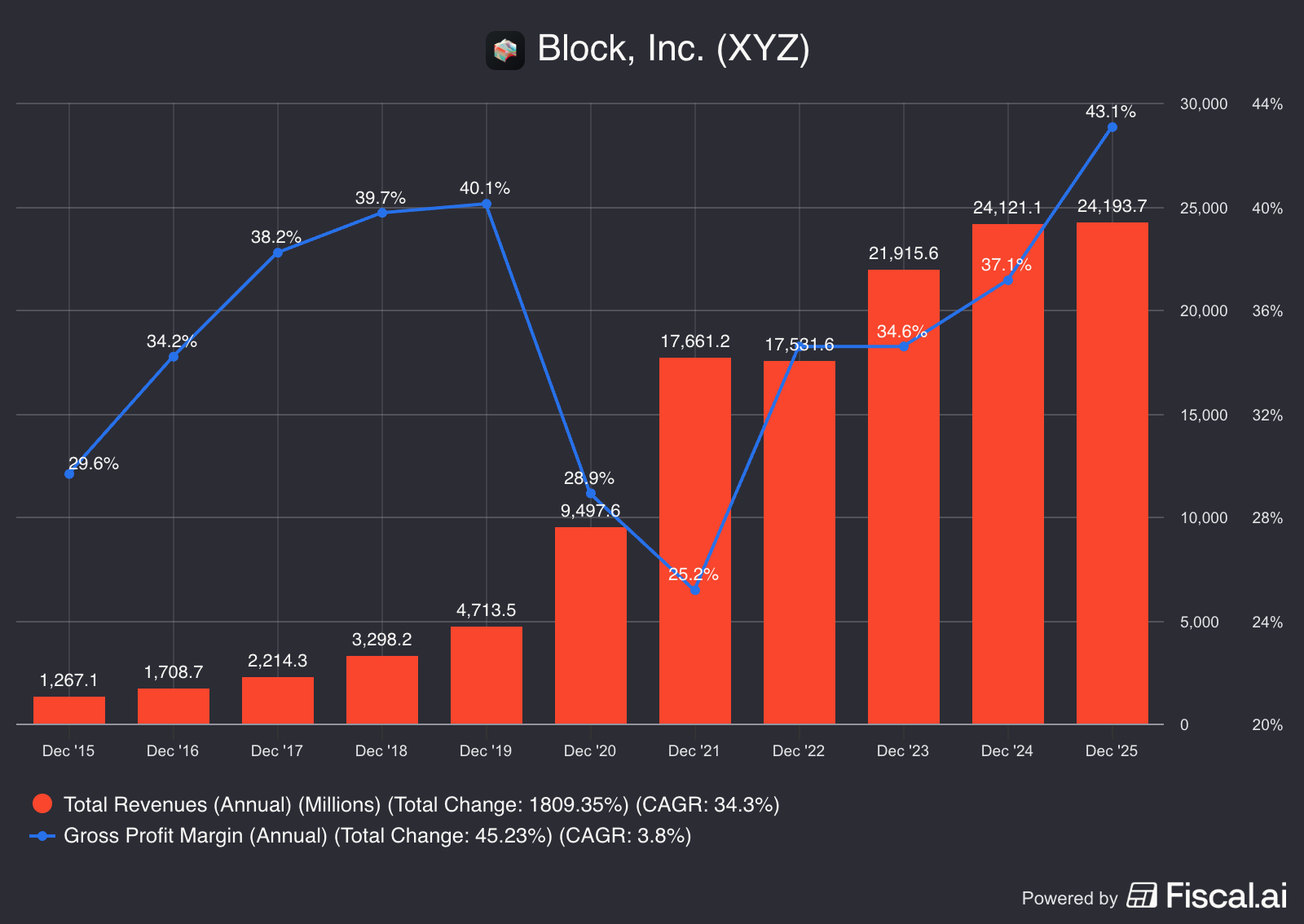
In my Q3 2023 earnings digest, I said the following about Block:
Management is not doing anything tangibly wrong. Nonetheless, for the reasons I explain above, I believe that the company lacks:
Clarity and focus.
A general regard for shareholders.
General Electric was a great case study on how deteriorating organisational properties can rapidly bring down an industrial giant. Block may just become an example of the opposite. In the graph below, it is now apparent that I was right to pick Spotify over Block and Shopify back in 2022. However, Block's evolving organisational properties have put me on high alert. Did I perhaps wrongly assess them back then and confuse a radical focus on achieving scale with shareholder unfriendliness?
I understand that to the average investor this means nothing. But over the years I have developed the conviction that correctly interpreting qualitative datapoints is the difference between making a fortune and making no money at all. I have also been teaching the importance of prioritising scale over profits in the digital economy for longer than the average analyst can endure to track. I may just have made that same mistake and will continue studying Block, to see what I can learn.
⚡ If you enjoyed the post, please feel free to share with friends, drop a like and leave me a comment.
You can also reach me at:
Twitter: @alc2022
LinkedIn: antoniolinaresc
Very intersting!!